Casa SM: The Roof as an Act of Precision and Flexibility
On October 2, 2019, I visited Architect Javier Sordo Madaleno’s house for the first time. We were close to complete the renovation of a tennis court on his property when, during that walkthrough, he shared his intention to build a new home. The initial excitement quickly turned into a sense of responsibility: the existing house was architecturally remarkable and carried a deep symbolic and family value.
That first visit also allowed me to reconnect with the Javier’s vision, which I had first encountered eleven years earlier in the book Arquitectura en Cuatro Elementos, accompanied by photographs by Ignacio Urquiza. It was there that I understood a constant in his work: the relationship between memory, landscape, and architecture. Simply walking through the entry gallery made this evident—a narrow glazed opening connected the interior to the garden, where an ash tree, planted by his mother decades earlier, anchored the family’s history to the site. That tree became the center of the project.
Months later, working with Javier and his sons Fernando and Javier, we defined a clear premise: to maintain a constant relationship between the ash tree and the main spaces. The new house would not frame it from a distance; but it would integrate it. From this idea, the roof emerged as the project’s main organizing system.
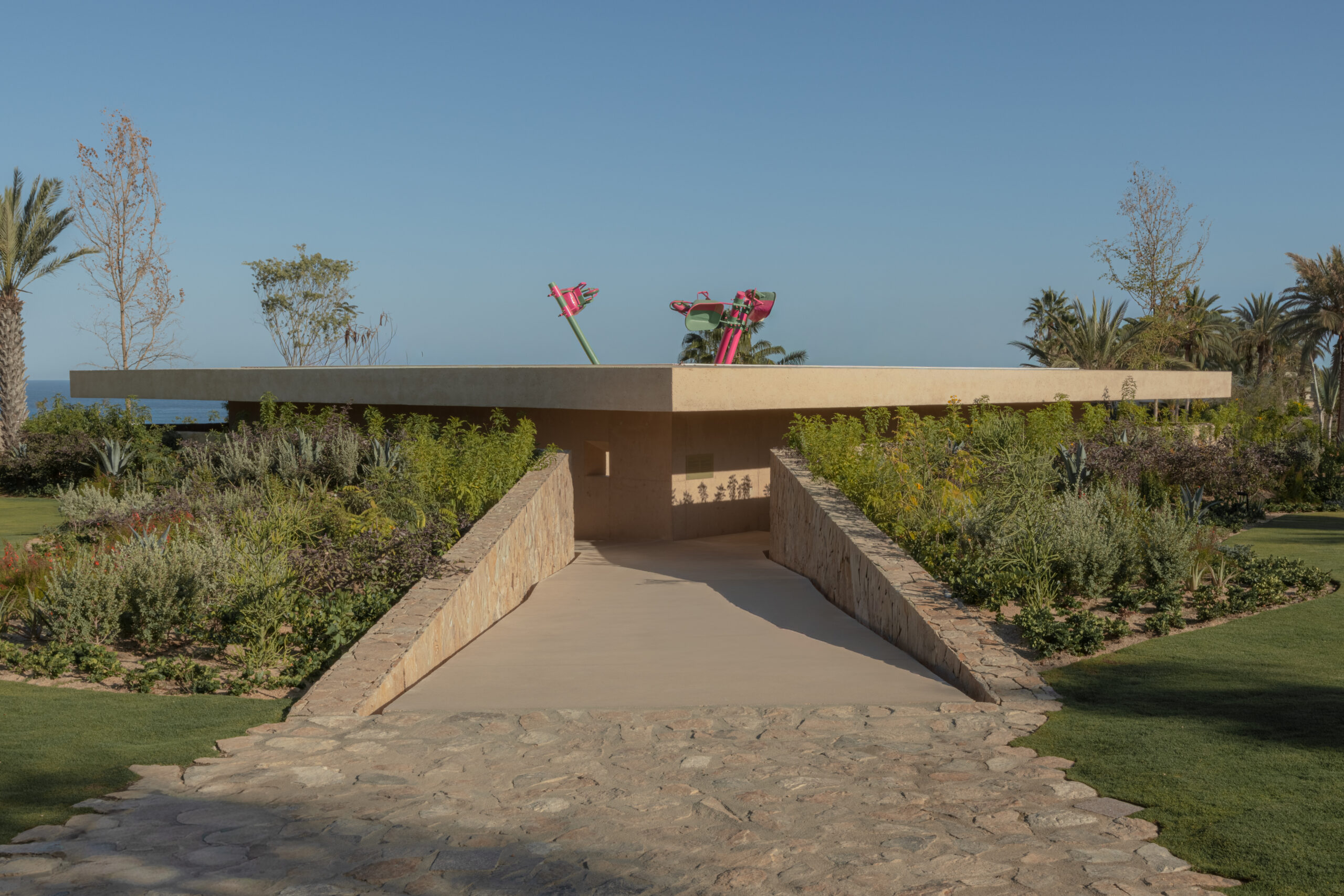
The proposal adopted an exposed concrete system, understanding structure as architecture. A monolithic roof—covering 992 m² of the house—rests on three longitudinal wall axes oriented toward the garden.
The goal was to balance mass and gravity while enabling flexible and generous spaces—with varying heights and scales depending on their use—for an evolving family. This required a clear design statement: understand architecture as a convergence of disciplines, where engineering, construction, building systems, and family dynamics coexist and demand versatility.
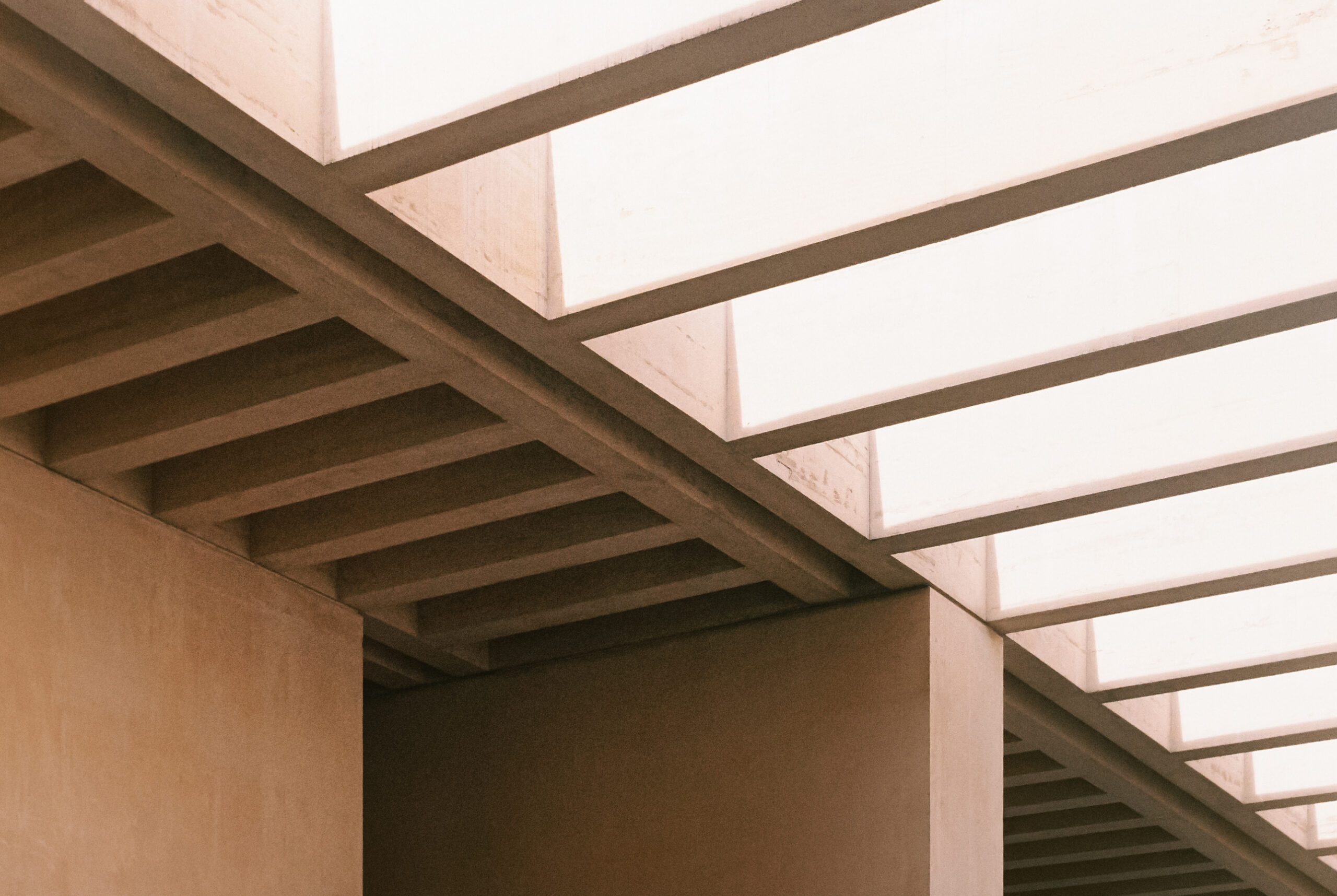
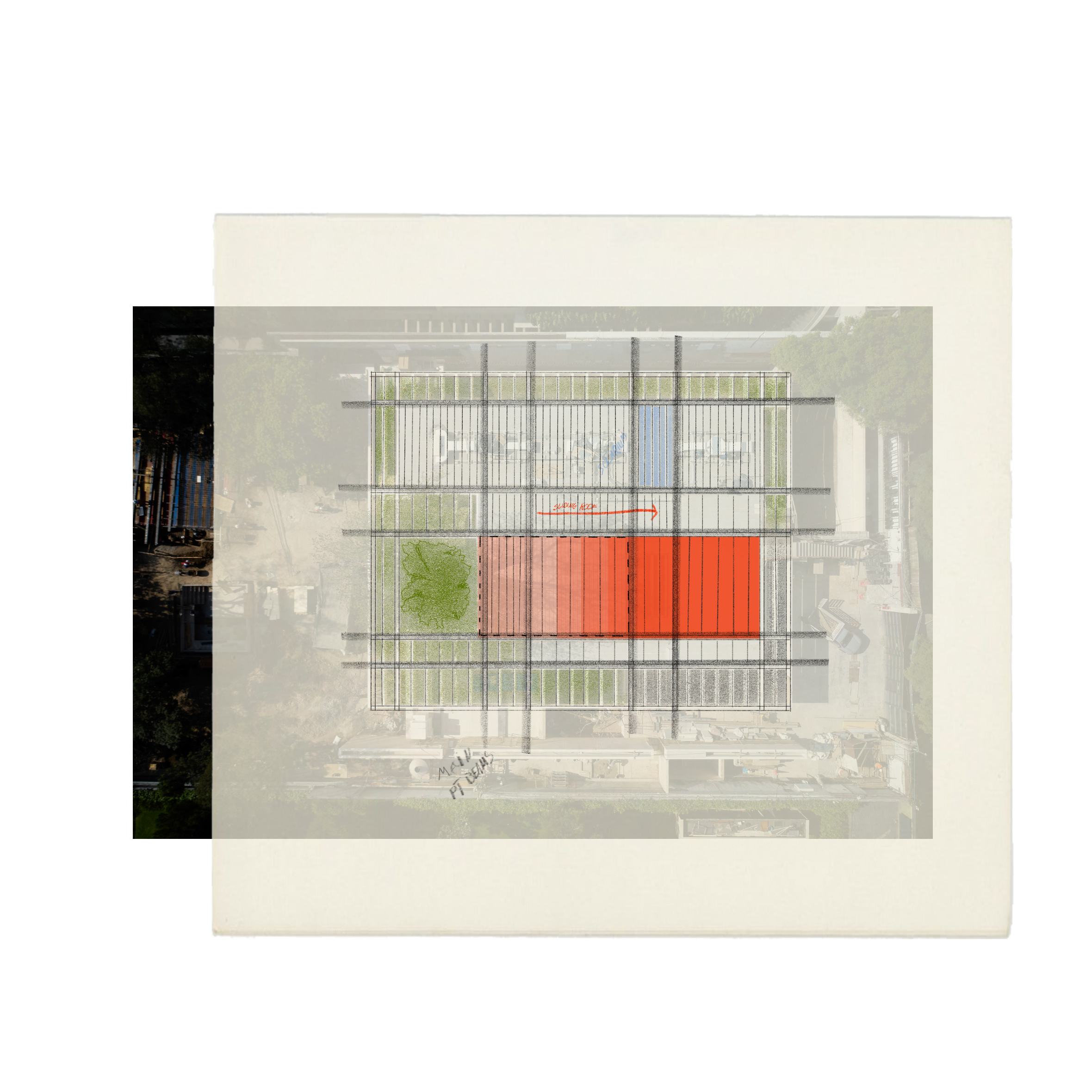
In the roof, as in the house, geometry is rigorous. It is composed of 29 transversal beams (20 × 80 cm, 28.06 m long) spaced at 1.22 m, and five longitudinal beams (61 × 80 cm, 35.38 m). The section never exceeds 80 cm height, achieving a slender expression across all façades, almost as if the structure were suspended. The system operates in three conditions: covered areas with a 20 cm slab and a secondary structure that modulates interior scale; open perimeter zones where the absence of the slab allows light to filter through the structural geometry; and finally, a void on the south side that interrupts the system to allow the tree structure to pass through.
This final gesture was not imposed—it was defined on site, adapting to the tree’s anatomy.
The concrete mix was designed using a white cement base, marble aggregates, and a light sand pigment to achieve a warm, elegant, and timeless tone. A self-compacting additive was incorporated to allow the entire roof to be poured in a single operation. Achieving this specification required multiple samples, mock-ups, and precise coordination between the design team, the contractor, and the concrete supplier.
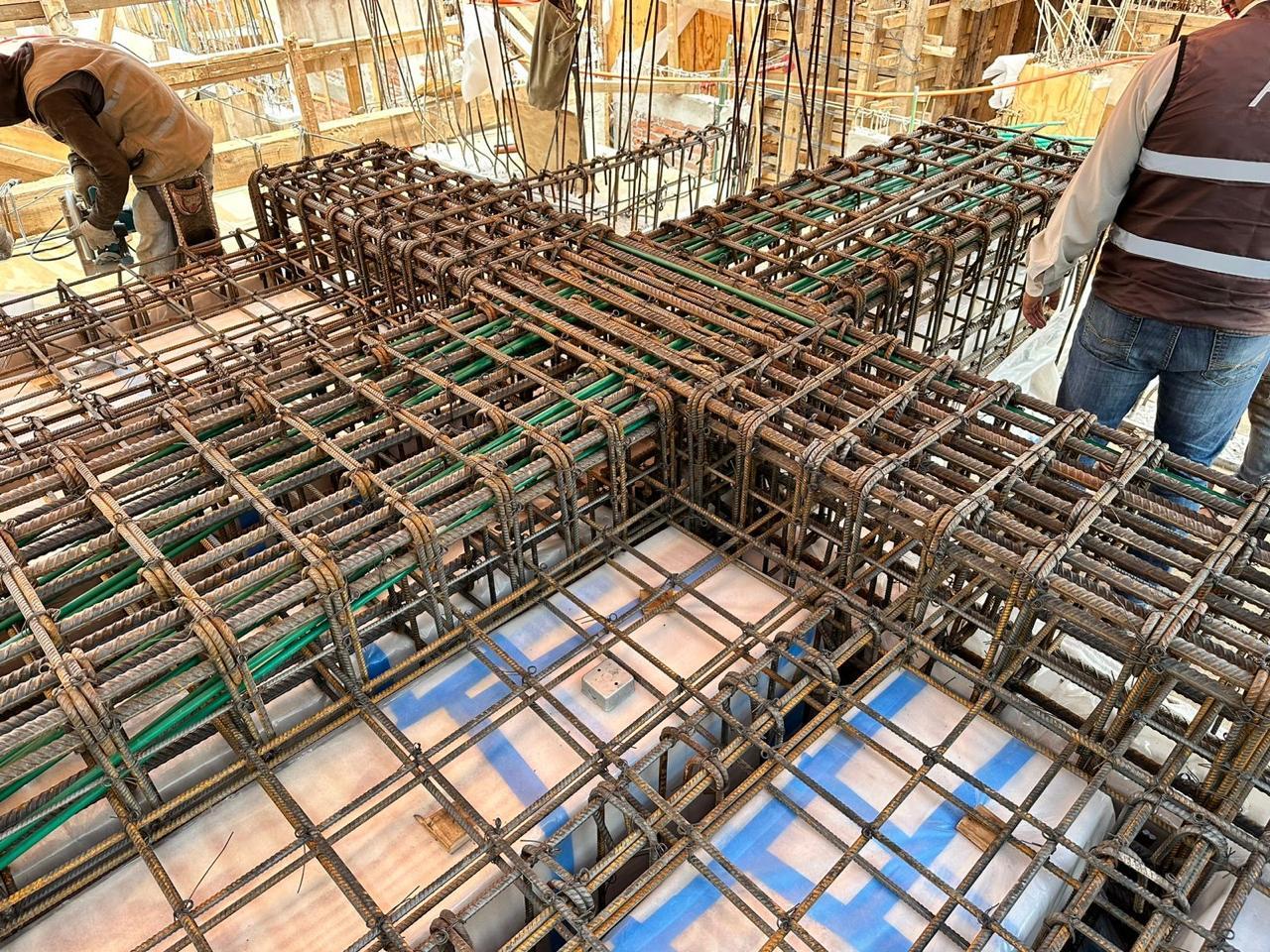
Structurally, a post-tensioned system was chosen, which is uncommon for projects of this type and scale. This strategy reduced the amount of reinforcing steel, controlled deflections, and optimized costs, particularly in cantilevered areas. The detailing was validated through both digital and physical testing with the specialist responsible for implementing the system.
The complexity of the roof also lies in the integration of lighting, HVAC systems, motorized windows and shading systems, as well as an automated retractable roof that allows the library to transform into a semi-outdoor space in approximately 45 seconds.
All of these elements were precisely coordinated within the formwork layout.
Planning took three months. In this type of construction process, there is no margin for error.
The concrete pour took place on February 17, 2024: 220 cubic meters of concrete over a continuous 14-hour operation, involving a team of 70 people and 21 trucks. It was an exercise in logistical precision.
Thirteen months later, the house was inaugurated.
To speak of the roof is to speak of the entire project: a synthesis of technique, memory, and time.